

The Transport System Is Part of the Munitions Program
Six ways the right transport system adds value, from the factory floor to the field.
Munitions programs across the U.S. and allied nations are accelerating. As they move from contract award toward higher-rate output, attention rightly goes to the rounds themselves and the lines that produce them. The equipment that moves finished cargo from the plant to the field gets far less of it.
That’s a gap worth closing. A well-designed transport system adds value across the whole program, from the first load at the factory to the moment the cargo is ready for use. One treated as an afterthought adds time, complexity, and risk at every handoff.
Here are six areas where the transport system earns its place as part of the program, not just part of the supply chain.
1. Loading that’s simple for operators
Every extra step in the loading process is a chance for delay or error. Operators working to production schedules need a process that’s intuitive, repeatable, and safe, without awkward angles or tight access.
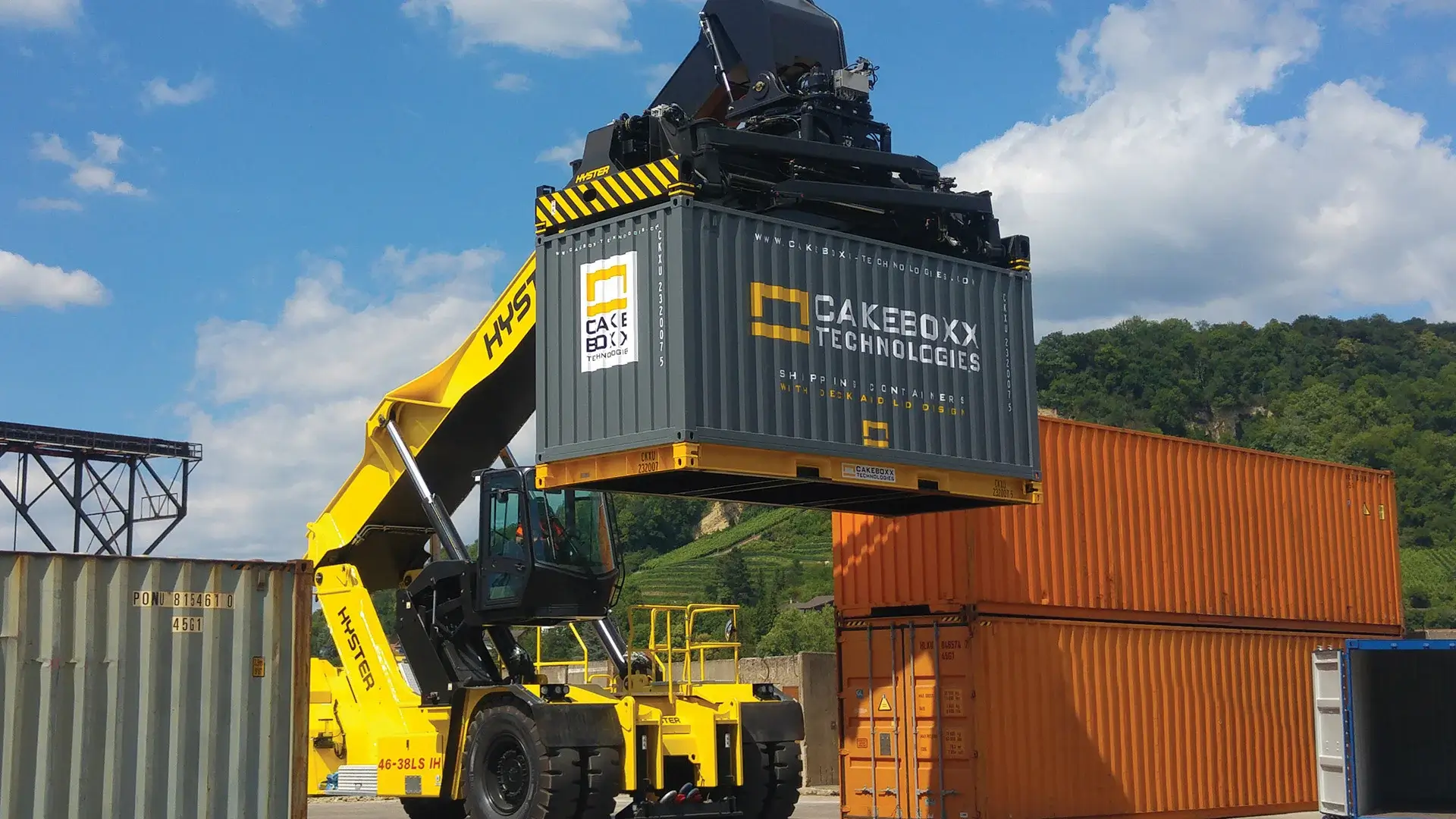
Conventional containers load through rear doors, which means pushing cargo end-first into a narrow opening. CakeBoxx’s patented two-piece design takes a different approach: the lid lifts off, and cargo is lowered onto an open deck from above or loaded from the side. Operators get clear access to every securing point, and loading becomes a controlled, visible process rather than a blind one.

With the lid lifted clear, cargo loads onto an open deck from above or the side.
2. Cargo safety in transit
Munitions are high-consequence cargo. They need to arrive in the condition they left, with no shifting, impact damage, or exposure to conditions outside their tolerances.
That starts with engineering. Securement designed around the specific cargo keeps each load restrained across road, rail, and sea legs. Where cargo is sensitive to shock or vibration, finite element analysis and drop testing during design help the container protect what’s inside. Tracking and environmental monitoring can be built in at the point of manufacture, so the condition of the cargo is known throughout the journey rather than assumed.

Tailored tie-down points let securement be laid out to suit the specific cargo.
3. Security without identity disclosure
The most secure shipment is one that doesn’t draw attention. A transport system that signals its contents, through a distinctive shape, markings, or visible fittings, creates risk before the cargo ever leaves the gate.
A container that moves through ports, rail yards, and highways like any other intermodal unit keeps the nature of its cargo out of view. Removing doors also removes the most common point of forced entry. CakeBoxx’s doorless two-piece models hold the Department of Homeland Security SAFETY Act Qualified Anti-Terrorism Technology (QATT) designation, reflecting how difficult they are to penetrate without authorization.
4. Maximizing transport capacity
Every trip that runs below capacity adds cost and time to the program. With output rising, how well each load uses the available space and weight allowance matters more than ever.
A transport system designed around the cargo, rather than adapted to it, can carry more per load while keeping safe spacing and securement. Deck layouts, cradles, and restraints tailored to the specific munition make better use of the footprint. And because a two-piece container is open on all sides during loading, space that would be lost to door clearance in a conventional unit can be put to work.
Dense cargo such as ammunition often reaches a container’s weight limit long before it fills the space. The half-height ShortBoxx® container is built for exactly this: at half the height of a standard high cube container, it can be loaded to its full weight rating using half the vertical space, and two units stack in the space of one.
5. A simple, secure return to base
The journey doesn’t end at delivery. Empty transport equipment has to come back ready for the next run, and the return leg should be as straightforward and secure as the outbound one.
With the two-piece design, the lid goes back on the deck and the unit is closed and ready to move again, with no complex reconfiguration. When securing fixtures are engineered as part of the container rather than added as loose dunnage, they travel back with it, so the system is ready to receive its next load as soon as it returns.
6. Unloading straight to operational readiness
This is where a well-designed transport system delivers its greatest value. When cargo arrives, operators should be able to bring it into service quickly, without rework or specialized intervention. Three things matter most:
- No adjustments required. Cargo arrives oriented and configured for use, so nothing needs to be reset before it’s operational.
- Speed and efficiency. Open access from above and the sides lets handling equipment reach the cargo directly, shortening the time from arrival to readiness.
- Simplicity. A straightforward unloading process reduces the training burden and the chance of error, especially in demanding field conditions.
When the transport system is developed in parallel with the cargo it carries, these outcomes can be designed in from the start rather than worked around later.
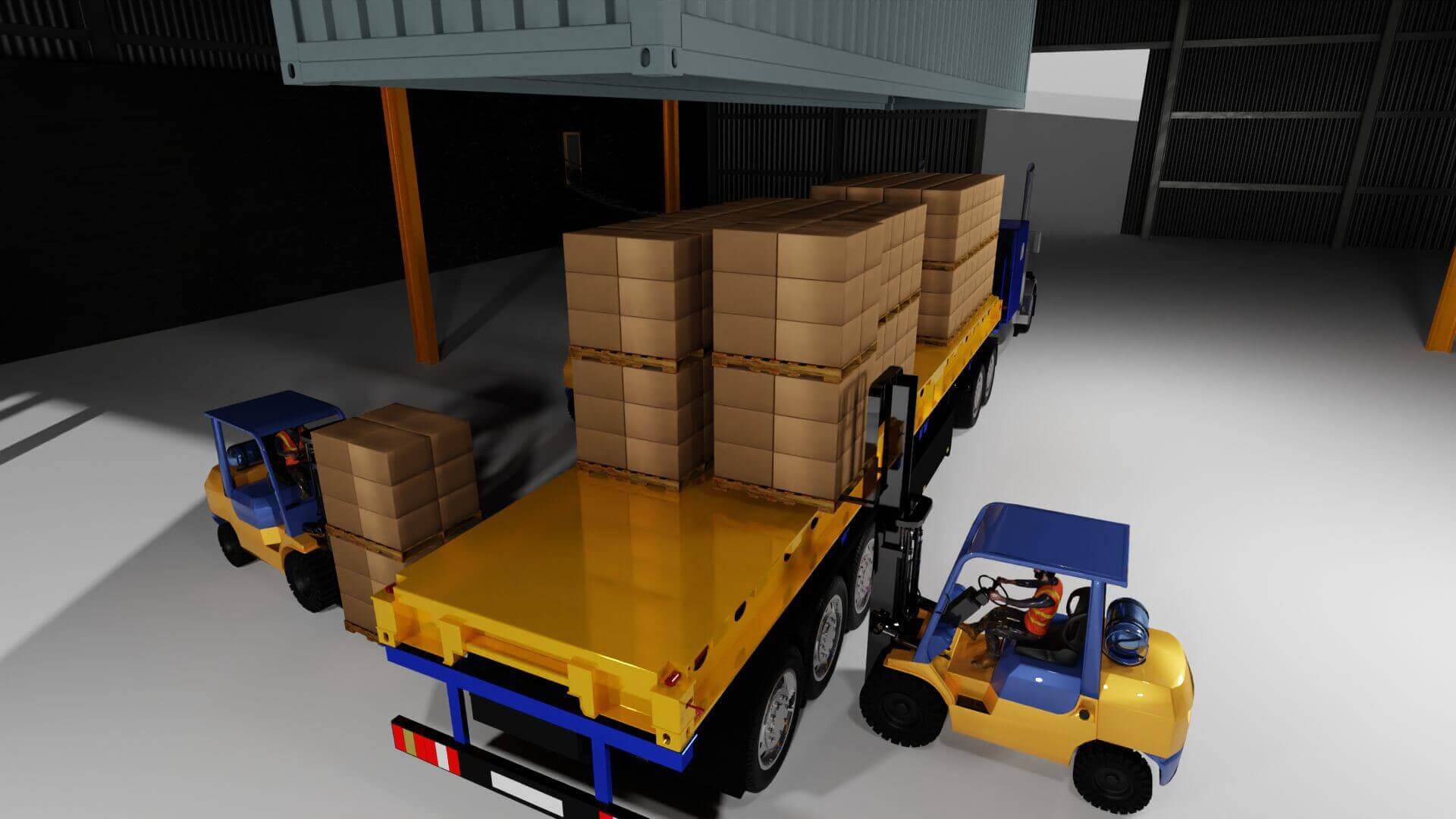
Open access from above and the sides lets handling equipment reach cargo directly on arrival. We call this Approachable Cargo™
Designed as part of the system
A well-designed transport system cuts the time and complexity operators face at every stage, from loading at the plant to readiness in the field. That directly supports the performance of the cargo itself.
As munitions programs accelerate, those that treat transport as an engineered part of the system, rather than equipment procured at the end, will be better placed to deliver on schedule. That’s the thinking behind our Systems Within Systems™ approach.
The standard two-piece container is one example of what we build, not the limit of it. Every CakeBoxx solution starts with the cargo and the mission, so its form follows the requirement. That can mean adapting the two-piece design itself, as with our ThermoBoxx™ reefers for environmental control, or moving beyond it to side-opening and one-piece containers with specialized features and heavy transport platforms rated up to 250 tons.
Whatever a program needs to move, store, or deploy, we work alongside defense programs to engineer the system around it.

Side-opening containers for long or awkward cargo.

ThermoBoxx™ two-piece reefers for environmental control.

Heavy transport platforms rated up to 250 tons.
Bring Us the Requirement
If your program is scaling toward higher-rate output, we’d like to help engineer the transport system alongside it.
📩 Contact our team to discuss your requirement, or download our Capabilities Statement and Product Catalog to see what we build today. You can also explore our aerospace and defense solutions.


